

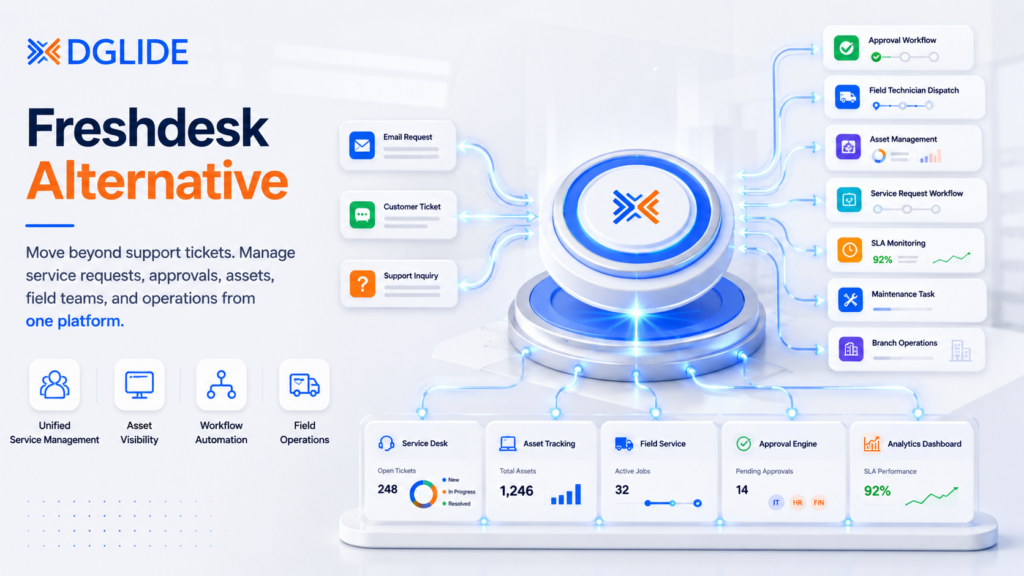
Most teams searching for a Freshdesk alternative are not unhappy with Freshdesk as a helpdesk. They are unhappy because their tickets stopped being support emails. A broken machine, a delayed installation, a spare-part request, a multi-department approval. Those are not conversations to reply to. They are work to resolve.
Freshdesk is built to answer and track customer conversations, and it does that well. The gap shows up when a Head of Service at a 60-technician equipment business, or an IT Head running cross-department approvals, needs the ticket to trigger a field visit, an asset update, or a workflow across three teams. That is where a helpdesk ends and an operations platform begins.
DGlide is a configurable operations platform. Its servicedesk module sits on the same backbone as field service, ITSM, and CRM, so a ticket can carry real operational work from request to closure. This guide compares the two honestly, including where Freshdesk is the better choice.
Short answer The best Freshdesk alternative depends on what your tickets really are. For a pure customer-support inbox, Zoho Desk, Help Scout, and Zendesk map closely to Freshdesk. For teams whose tickets trigger real-world work like field visits, installations, asset requests, or cross-department approvals, a configurable operations platform like DGlide fits better, because it is built to resolve work, not just respond to conversations.
TL;DR
- Freshdesk is a strong customer-support helpdesk, priced per agent from about $19 to $89 per agent per month billed annually, with its most capable AI sold as a separate add-on.
- The channels many teams want, like WhatsApp, Instagram, SMS, and telephony, sit in Freshdesk Omni, a higher-priced product at $29 to $119 per agent per month.
- Most “Freshdesk alternative” searches are really a hunt for another helpdesk. If your tickets are operational, the whole category is the wrong fit.
- The Reply-vs-Resolution Gap: a helpdesk closes the ticket when you reply. Operations work closes when a technician fixes the asset, a part ships, or an SLA is met across teams.
- DGlide is a configurable operations platform whose servicedesk connects tickets to field service, ITSM, and CRM on one backbone.
- Where Freshdesk wins: more channels, a mature autonomous AI agent, community forums, a bigger app marketplace, and transparent self-serve pricing with a free tier.
- Where DGlide wins: configuration without rebuilds, tickets tied to real-world workflows, native field service, and fit that holds as your operations change.
- Honest fit: DGlide suits operations, field-service, and IT-support teams. It is not the pick for a pure social-support inbox.
Why Teams Start Looking for a Freshdesk Alternative
The most common trigger is cost that climbs with headcount. Freshdesk is priced per agent, at roughly $19 for Growth, $55 for Pro, and $89 for Enterprise, per agent per month billed annually. Add agents, and the bill grows in a straight line.
The second trigger is the channels question. Email and a web portal come with base Freshdesk, but WhatsApp, Instagram, SMS, and telephony live in Freshdesk Omni, which runs $29 to $119 per agent per month. The omnichannel support most teams assume is included is actually a higher-priced product.
The third trigger is the one that sends operations teams away from helpdesks entirely. The features that decide real work, like approval workflows, skills-based assignment, and audit logs, sit on the $89 Enterprise tier. For a service business, those are not premium extras. They are the job.
📊 65% of customers expect companies to adapt to their changing needs When your software cannot adapt with you, you cannot adapt to them. That is the hidden cost of a tool that fits the category but not your operation.
Source: Salesforce, State of the Connected Customer
A 40-person facility-management operation does not leave Freshdesk because the inbox is bad. It leaves because the inbox cannot dispatch an engineer, log an asset reading, or route an approval to the regional manager. This is where the gap between standardization and fit starts to matter, and where a configurable ticket management approach changes the math.
See how a servicedesk built for operational tickets handles dispatch and SLA in one flow at dglide.com.
The Reply-vs-Resolution Gap
Here is the assumption worth challenging. The industry treats every inbound issue as a support ticket, and every support ticket as something you close with a good reply. The reality for operations teams is different. Many of their tickets are not closed by words at all.
Run this five-minute diagnostic. Take your last 20 tickets and sort them into two piles. Pile one: issues resolved by a reply, a link, or a refund. Pile two: issues that needed a person on site, a part shipped, an asset updated, or another department to act. If pile two is larger, you do not have a support problem. You have an operations problem, and a helpdesk is the wrong tool for it.
This matters because the cost of the second pile is real and measurable. In field service, the average first-time fix rate sits around 77%, according to Service Council research, which means roughly one in five jobs needs a second visit. A helpdesk has no view into that second visit, because its job ended when the ticket was acknowledged.
⚠️ The hidden failure mode A helpdesk can show a 95% on-time reply rate while your actual resolution rate quietly slips. The ticket looks closed. The customer is still waiting for the technician. Reply metrics hide resolution debt.
DGlide is built around resolution, not reply. A ticket logged in its ticket management built for operations teams can open a work order, assign a technician, track the visit, and close only when the work is verified. The conversation is one part of the record, not the whole record.
DGlide vs Freshdesk: The Complete Feature Comparison
The fairest way to compare these two is to stop scoring them as two helpdesks. Freshdesk is the deeper helpdesk. DGlide is a lighter helpdesk attached to a wider operations platform. This is the full picture, grouped by what you actually evaluate. Freshdesk pricing and AI terms are verified on freshworks.com as of June 2026.
Platform and category
| Capability | Freshdesk | DGlide |
| Product category | Customer-support helpdesk | Configurable operations platform |
| Underlying architecture | Fixed product, configured within limits | No-code and low-code configuration |
| Connected modules | Separate Freshworks products (Freshservice, Freshsales, FSM add-on) | Servicedesk, ITSM, FSM, CRM on one backbone |
| Core job | Answer and track conversations | Resolve operational work to closure |
Channels and omnichannel
| Channel | Freshdesk | DGlide |
| Yes | Yes | |
| Web forms | Yes | Yes |
| Live chat | Via Freshdesk Omni | Yes |
| Via Freshdesk Omni | Yes | |
| Via Freshdesk Omni | Yes | |
| Via Freshdesk Omni | Yes | |
| SMS | Via Freshdesk Omni | Yes (Twilio) |
| Telephony | Via Omni or Contact Center | Yes |
| X (Twitter) | Via Freshdesk Omni | No |
| Telegram, WeChat, LINE | Via Freshdesk Omni | No |
Agent productivity and ticket handling
| Feature | Freshdesk | DGlide |
| Quick ticket (peek) view | Yes | Yes |
| Work modes (prioritize by due date, priority, status) | Yes | Partial |
| Table or grid view | Yes | Partial (web) |
| Canned responses and snippets | Yes | Partial (templates) |
| Email templates | Yes | Yes |
| Split ticket or multiple tasks per ticket | Yes | Yes |
| Clone ticket | Via marketplace | No |
| Mobile app | Yes | Yes |
Self-service and knowledge
| Feature | Freshdesk | DGlide |
| Multilingual knowledge base | Yes | Yes |
| Multi-brand help center | Yes | Yes (portal workspace) |
| Community forums | Yes | No |
| Support chatbot | Yes (Freddy) | Partial (Glider Bot) |
| Guided conversations | Yes | Partial (conversation flow) |
AI and automation
| Feature | Freshdesk | DGlide |
| Reply assistant | Add-on (Freddy Copilot) | Partial (Glider Bot) |
| Autonomous AI agent | Add-on (Freddy Agent, usage-priced) | Partial (Glider Bot) |
| Ticket auto-tagging | Yes | Yes |
| AI categorization and routing | Yes | Yes |
| AI prioritization | Yes | Yes |
| Advanced AI (sentiment, predictions) | Higher tier or add-on | No |
Customization and configurability
| Feature | Freshdesk | DGlide |
| Custom ticket status and grouping | Yes | Yes |
| Custom form fields and layouts | Yes | Yes |
| No-code workflow automation | Yes (follow-ups, escalations) | Yes (whole workflows) |
| Configurable forms and field logic | Within helpdesk limits | Yes |
| Custom objects and advanced routing | Pro tier and up | Yes |
Analytics and reporting
| Feature | Freshdesk | DGlide |
| SLA dashboards | Yes | Yes |
| Agent dashboards | Yes | Yes |
| Custom dashboards | Yes | Yes |
| Response, resolution, and FCR dashboards | Yes | Yes |
| AI analytics dashboard | Yes | No |
| Audit logs | Enterprise tier | Yes |
Field service and operational closure
| Capability | Freshdesk | DGlide |
| Work order creation and tracking | Separate FSM add-on | Yes (native) |
| Technician assignment and scheduling | Separate FSM add-on | Yes |
| Preventive maintenance auto work orders | No | Yes |
| Technician mobile task visibility | FSM add-on | Yes |
| Route tracking | No | Yes |
| Distance-based expense calculation | No | Yes |
| OTP-based work order closure | No | Yes |
| Customer verification before closure | No | Yes |
| Tool and asset management | No | Yes |
Pricing and access
| Item | Freshdesk | DGlide |
| Public pricing | Yes | No |
| Pricing model | Per agent, plus AI add-ons | No specific or published model (custom only) |
| Free tier | Yes ($0, 1 to 2 agents, 6 months) | No |
| Base helpdesk plans | $19 / $55 / $89 per agent per month (annual) | Not published |
| Full omnichannel (Omni) plans | $29 / $79 / $119 per agent per month (annual) | Not published |
| AI cost | Freddy Copilot separate; Freddy Agent $49 per 100 sessions after 500 | Not published |
| Self-serve onboarding | Yes | No (guided) |
Notes. Verified June 2026: base Freshdesk centers on email, web, and portal. WhatsApp, Instagram, SMS, telephony, and other messengers are delivered through Freshdesk Omni, priced higher. Freddy AI terms verified on freshworks.com. DGlide “Partial” reflects the earlier-stage Glider Bot assistant, and DGlide channel rows are from its current servicedesk. Freshdesk core has no native field service; Freshworks sells it as a separate paid module. DGlide has no published pricing model and is sold via custom quote.
1. Channels and omnichannel support
Freshdesk wins on breadth. Across Freshdesk Omni it covers email, web, chat, WhatsApp, Facebook, Instagram, SMS, telephony, and the long tail like X, Telegram, WeChat, and LINE. DGlide covers the channels most operations teams use, including email, chat, web forms, WhatsApp, Facebook, Instagram, SMS, and telephony, but not the long-tail messengers today.
For a D2C brand fielding queries across five social apps, Freshdesk is the safer choice. Worth noting on cost: those extra channels arrive through Freshdesk Omni at $29 to $119 per agent per month, not the base $19 to $89. The breadth is real, but it is a higher-priced product. Winner: Freshdesk
2. Agent productivity and ticket handling
This one is close. Both offer quick ticket views, email and canned-response templates, and ticket splitting. Freshdesk adds clone-ticket through its marketplace for power users.
DGlide’s twist is operational. Its ticket split maps to creating several tasks against one request, which fits work where a single ticket spawns multiple jobs. Its work modes let an agent prioritize by due date, priority, and status. Winner: Freshdesk on pure agent tooling, with DGlide closing the gap where one ticket becomes many tasks.
3. AI and automation
Freshdesk is ahead on AI maturity, and you pay for that lead. Freddy AI Copilot is a separate purchase. Freddy AI Agent is included for the first 500 sessions, then $49 per 100 sessions, and only on Pro and Enterprise. The deeper predictions, like sentiment analysis, sit on higher tiers.
DGlide includes AI-assisted categorization, routing, prioritization, and auto-tagging in the platform itself, with the conversational Glider Bot still earlier stage. So the honest split is clear. Winner: Freshdesk on autonomous AI depth, DGlide on the AI you do not pay extra to switch on.
4. Self-service and knowledge
Freshdesk leads here. Both tools offer a multilingual knowledge base and a multi-brand help center, which DGlide delivers through portal workspaces. The difference is deflection.
Freshdesk has community forums and a more mature support chatbot for guided self-service. DGlide has no community forums, and its chatbot is earlier stage. For a high-volume consumer brand that deflects tickets through forums and bots, this gap is real. Winner: Freshdesk.
5. Customization and configurability
Here the platform DNA flips the result. On surface helpdesk customization, like custom fields and statuses, the two are even. The deeper difference is what each can reshape.
Freshdesk bends within the helpdesk shape it ships with, and the heavier configuration lands on Pro and Enterprise. DGlide configures whole workflows, forms, and field logic without code, because it is a configurable operations platform rather than a fixed product. This is the practical meaning of fit over standardization. Freshdesk adapts you to the tool. DGlide adapts the tool to your operation. Winner: DGlide.
6. Analytics and reporting
Near tie. SLA dashboards, agent dashboards, custom dashboards, and response, resolution, and first-contact-resolution reporting are present in both, and DGlide includes audit logs that Freshdesk gates to Enterprise.
The one clear Freshdesk edge is a more developed AI analytics dashboard. Winner: Tie, with a Freshdesk edge on AI analytics and a DGlide edge on audit logs at lower cost.
7. Field service and operational closure
No contest, and this is the reason the comparison exists at all. Freshdesk has no native field service. It cannot raise a work order, assign a technician, track a route, calculate distance-based expense, or confirm on-site closure with an OTP.
DGlide does all of this on the same platform, because the servicedesk shares a backbone with field service management. A ticket from a 60-technician equipment manufacturer becomes a dispatched job with a verified close, not a longer email thread. Winner: DGlide, structurally.
8. Pricing model and total cost
These are different shapes, so the honest answer depends on your size. Freshdesk is transparent and self-serve. It is free for one to two agents, then roughly $19, $55, and $89 per agent per month billed annually for the helpdesk, and $29 to $119 once you add full omnichannel through Omni, plus AI add-ons.
DGlide has no published pricing model and is sold by custom quote. That opacity is a real friction for a self-serve buyer, and Freshdesk’s free tier and transparent tiers win outright for small support teams. For a multi-team operation consolidating several tools, DGlide’s platform deal can still come out lower than stacked per-agent Omni plans plus AI add-ons, but you have to ask for the number. Winner: Freshdesk on transparency and small-team entry, DGlide only on potential multi-team consolidation.
The scorecard
| Dimension | Edge | Why it matters for your team |
| Channels and omnichannel | Freshdesk | More channels, though through higher-priced Omni |
| Agent productivity | Freshdesk (slight) | Clone-ticket and marketplace depth |
| AI and automation | Split | Freshdesk deeper, DGlide included |
| Self-service and knowledge | Freshdesk | Community forums and mature chatbot |
| Customization and configurability | DGlide | Reconfigures whole workflows without code |
| Analytics and reporting | Tie | Even, with offsetting edges |
| Field service and closure | DGlide | Native dispatch and verified closure |
| Pricing model | Split | Freshdesk for small teams, DGlide for multi-team consolidation |
The pattern is the honest one. If you are buying a helpdesk, Freshdesk wins more dimensions, and you should probably keep it or move to Zoho Desk or Zendesk. If your tickets are operational, DGlide wins the two dimensions that decide your day, configurability and operational closure, and the helpdesk scoreboard stops being the right scoreboard.
Walk through a DGlide servicedesk configured around your actual workflow, not a generic inbox, with the team at dglide.com.
Other Freshdesk Alternatives Worth Considering in 2026
No single tool wins for everyone, so here is an honest shortlist. Entries are alphabetical, chosen for their prominence in current search results and category fit, each with one honest limitation. Reviewed June 2026.
- DGlide is best when your tickets drive real-world operations across field, service, and IT teams. Limitation: it is not built for a pure customer-support inbox, and there is no public free tier.
- Gleap offers flat-rate plans with unlimited agents plus bug reporting and session replay. Limitation: it is focused on SaaS and app teams, so it is narrower for traditional operations.
- Help Scout is a clean shared inbox for small teams that want simplicity. Limitation: it is limited for complex multi-department or field workflows.
- Intercom is strong on real-time messaging and autonomous AI bots. Limitation: its usage-based AI pricing climbs quickly at scale.
- osTicket is a free, open-source workhorse. Limitation: you host, secure, and maintain it yourself.
- Zendesk is the enterprise standard with deep customization. Limitation: cost and complexity overshoot small and mid-sized teams.
- Zoho Desk is the closest one-to-one Freshdesk replacement and strong inside the Zoho suite. Limitation: best value only if you adopt the wider Zoho suite.
When DGlide Is the Right Fit, and When It Is Not
Honesty here saves everyone a wasted demo. DGlide is the right Freshdesk alternative for a specific kind of team, and the wrong one for another.
DGlide fits when you are an operations, field-service, or IT-support team whose tickets trigger physical work, asset changes, SLAs, or cross-department approvals.
It fits a machinery manufacturer running installations and after-sales, a facility-management firm coordinating engineers, or an internal IT team tying ticketing to asset and service workflows. It fits teams that want to configure the system to their process instead of building software from scratch.
DGlide is not the right pick if you only need a customer-support inbox. If your work is answering high-volume support across a dozen social channels, with autonomous AI and a free starting tier, then Zoho Desk, Help Scout, or Zendesk will serve you better. There is no value in forcing an operations platform onto a pure support team.
📊 67% of consumers expect a support issue resolved within 3 hours Speed is now the baseline, and for operations teams the clock runs across departments, not just the inbox. Cross-team resolution, not faster typing, is what moves it.
Source: HubSpot, State of Customer Service
What Switching Actually Looks Like
Moving off a helpdesk sounds heavy, which is why most teams delay it. With a configurable platform, the switch is a configuration, not a 12-month software project. DGlide follows a lifecycle that does not stop at launch.
- Deploy. Start on a working servicedesk configured to your real ticket types, stages, and SLAs, so you go live in weeks rather than quarters.
- Use. Your team runs daily tickets inside one system that maps to how the work actually flows, including the field and approval steps a helpdesk skips.
- Adapt. When a new product line, region, or process appears, the workflow is reconfigured to match it, without a rebuild or a developer queue.
- Optimize. Real usage shows what to tighten, and the system is refined around it, so fit improves over time instead of eroding.
This is the core idea behind the Living Service Model. Deployment is not the finish line. Fit is. Standard helpdesks ship, declare victory, and freeze. Your operation changes 90 days later, and the tool that fit on day one slowly stops fitting.
In 2026, two shifts make this urgent. AI add-on pricing is rising across helpdesk vendors, and operations teams are consolidating disconnected tools to cut both cost and handoff errors.
A platform that already connects field service and ticketing answers both at once. You can see how teams approach the move in DGlide’s customer stories, and a related read covers service desk alternatives for field teams.
The Bottom Line
Freshdesk is a capable helpdesk, and if your work is genuinely customer support, you may not need to leave it. The question is not whether Freshdesk is good. It is whether your tickets are conversations or work.
If your tickets end in a reply, keep a helpdesk and pick the one that fits your channels and budget. If your tickets end in a fixed machine, a completed install, or a met SLA across teams, you need a system that resolves work, not one that closes conversations. That is the line between a helpdesk and an operations platform.
Map your own reply-vs-resolution gap with the DGlide team and see a servicedesk built around your operation at dglide.com.
Frequently Asked Questions
Yes, several. osTicket is free and open-source, though you host and maintain it yourself. Zoho Desk and Freshdesk itself offer limited free tiers for small teams. DGlide does not offer a public free tier, because it is a configurable operations platform aimed at teams whose tickets drive real-world work.
For teams whose tickets trigger field visits, installations, or cross-department work, an operations platform fits better than a helpdesk. DGlide combines a servicedesk, field service, and ITSM on one configurable backbone. Pure customer-support teams are usually better served by Zoho Desk or Help Scout.
Freshdesk is priced per agent, from about $19 to $89 per agent per month billed annually for the helpdesk, and $29 to $119 for full omnichannel through Freshdesk Omni. Its most capable AI is a separate add-on. Alternatives range from free open-source tools to platform-based pricing sold by quote.
DGlide is a strong Freshdesk alternative for operations, field-service, and IT-support teams that need tickets connected to real-world workflows. It is configured without code and suits teams whose processes change often. It is not the right pick for a team that only needs a customer-support inbox.
