

India’s Field Service Management software market was valued at approximately $180 million in 2024 and is projected to reach $340 million by 2027, driven by telecom infrastructure expansion and BFSI branch operations growth.
The growth is not coming from enterprise-grade implementations. It is coming from mid-market operations teams that can no longer manage field dispatch across cities through WhatsApp groups, Excel sheets, and phone calls.
The operational failure pattern is consistent. The IT ticket is logged correctly in Freshservice or ServiceNow. The field technician coordination moves outside the system entirely.
Operations managers lose visibility the moment escalation begins, and SLA breach incidents compound because nobody can confirm whether the engineer accepted the task, reached the site, or resolved the issue.
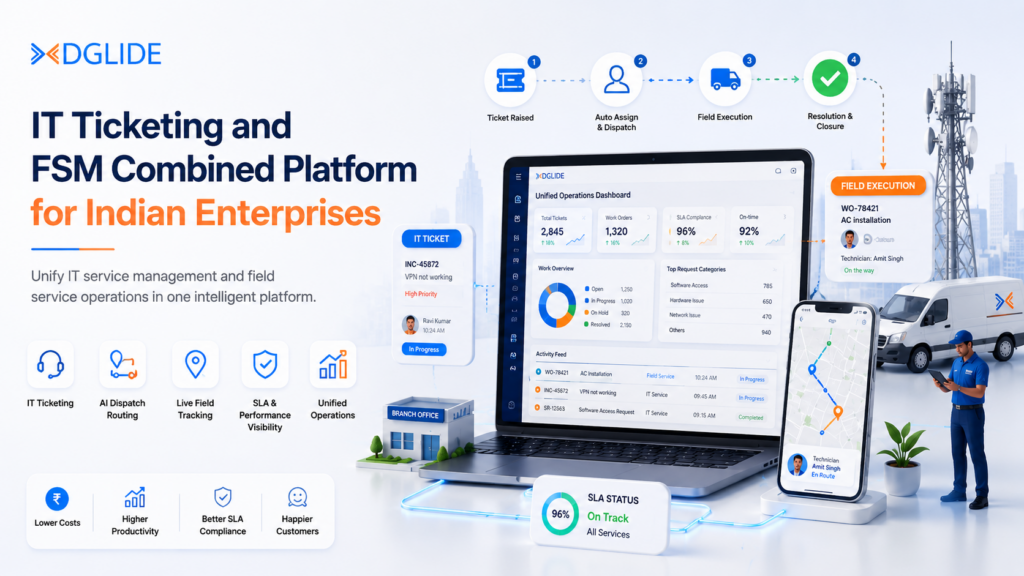
A combined IT ticketing and Field Service Management (FSM) platform closes that gap by connecting the digital desk to physical field execution inside one workflow.
Key Takeaways
-
Separate IT ticketing and Field Service Management systems create SLA visibility gaps after escalation
-
WhatsApp-based dispatch coordination fails the moment operations expand to a second city
-
Unified ITSM and FSM platforms route incidents from digital alert to GPS-dispatched field engineer automatically
-
AI dispatch routing assigns the nearest qualified technician in under 60 seconds without manual queue management
-
Indian mid-market businesses now prefer no-code workflow platforms that deploy in days, not months
-
DGlide connects IT ticket escalation directly to field execution inside a single operational workflow
What Is a Combined IT Ticketing and FSM Platform?
A combined IT ticketing and Field Service Management platform connects IT service desk workflows with technician dispatch and field execution inside a single operational system.
These platforms are used by Indian telecom companies, BFSI operations teams, facility management firms, and multi-city service organisations where digital incidents require physical field resolution.
An IT Manager running separate ITSM and dispatch tools typically loses operational visibility after escalation begins. The ticket remains visible in the IT desk. The technician workflow moves outside the system entirely.
A unified Field Service Management platform removes that handoff gap by automating the path from digital alert to dispatched engineer.
What Is the Difference Between ITSM and FSM?
IT Service Management (ITSM) platforms manage incident tickets, escalation queues, asset records, and service requests. Field Service Management platforms manage technician scheduling, dispatch workflows, field execution, and service completion tracking.
Teams evaluating IT Service Management systems often discover the FSM gap only after their first multi-city SLA breach.
When these two systems operate separately, operations teams manually bridge the gap between ticket escalation and field execution. That creates delays, duplicate coordination, and SLA visibility problems that scale badly across cities.
Which Indian Industries Need a Combined Platform Most?
Combined ITSM and FSM platforms are most commonly deployed in:
-
Telecom infrastructure operations: Managing network incidents, tower maintenance, technician dispatch, and SLA tracking across cities.
-
BFSI branch maintenance: Coordinating ATM servicing, branch hardware support, and incident escalation workflows.
-
Multi-city facility management: Coordinating maintenance teams, field engineers, and service requests across locations.
-
Healthcare service networks: Managing medical equipment servicing, IT incidents, and field support requests through centralized workflows.
-
Retail hardware support operations: Handling POS machine issues, store hardware incidents, and technician dispatch through connected ticketing systems.
-
Logistics service operations: Managing warehouse incidents, tracking-device maintenance, and field service coordination.
These industries share a single dependency: field response visibility tied to SLA-driven operational coordination.
📊 India’s FSM software market is growing at 19% CAGR, from $180M in 2024 toward $340M by 2027: Telecom infrastructure expansion and BFSI branch digitisation are the two primary growth drivers.
Source: Mordor Intelligence, India Field Service Management Market Report, 2024
Why Running Separate IT Ticketing and FSM Tools Is Costing Indian Businesses More Than They Realise
Most Indian operations teams believe their current setup is “messy but manageable.” The actual operational cost appears during escalations, SLA breaches, and multi-city coordination failures, not in day-to-day operations.
Operations teams running disconnected ticket management workflows and FSM tools lose hours per SLA breach incident to manual escalation and re-routing. Unified operational workflows reduce that delay to under 15 minutes.
The Hidden Cost of Manual Escalation Handoffs
“What gets measured gets managed.” Peter Drucker, Management Consultant and Author
Source: The Drucker Institute
Most SLA breaches happen after ticket escalation, not before it. The ticket reaches the correct queue. The dispatch coordination becomes manual.
Operations managers then lose time tracking technician acknowledgements, field updates, escalation ownership, and repeat incidents across disconnected systems. Each gap compounds the delay.
Why WhatsApp-Based Field Dispatch Breaks at Scale
WhatsApp-based dispatch workflows may function for small single-city teams. Once operations expand across multiple cities, dispatch ownership and technician visibility become inconsistent almost immediately.
A Bengaluru escalation stays unresolved because the ticket sits in one system while the technician assignment happens in a WhatsApp group. The operations manager has no way to confirm acknowledgement, location, or status without making a phone call.
The SLA Breach Cycle That Repeats Because Ticket and Technician Live in Different Systems
When ITSM and FSM systems remain disconnected, the same operational failures repeat:
-
Late dispatch updates: Field engineers share updates manually, delaying real-time visibility for support teams.
-
Manual ticket closures: IT teams close tickets manually because field resolution data does not sync automatically.
-
Repeated escalations: The same incidents are escalated again because ticket history and field actions remain fragmented.
-
Unclear SLA ownership: Operations teams cannot identify who is responsible when response timelines are breached.
The operational blind spot continues repeating until ticketing and execution workflows operate together inside one platform.
🚨 If your field engineers are still receiving job details through WhatsApp screenshots while the ITSM ticket stays open in Freshservice, that is the integration layer failing, not your team. See how DGlide connects your IT desk to GPS-dispatched field engineers in under 60 seconds.
How a Unified IT Ticketing and FSM Platform Works: From Digital Alert to Field Resolution
Unified ITSM and FSM platforms connect incident escalation directly with field execution workflows. Instead of manually forwarding incidents to field teams, the workflow automatically routes, dispatches, tracks, and resolves service requests inside one operational layer.
This is the five-step process a unified platform runs automatically:
-
Alert generation: An incident ticket is generated through software alerts, customer complaints, asset monitoring, or branch escalation. The workflow system captures the issue and creates a structured ticket immediately.
-
AI triage and routing: The platform categorizes the incident and identifies severity level, SLA urgency, asset type, city location, and escalation owner, prioritizing incidents without manual queue management.
-
Technician assignment: The dispatch engine identifies the nearest qualified technician based on GPS proximity, workload, skill certification, and availability, reducing manual coordination during critical incidents.
-
Field dispatch: The assigned technician receives task details, asset history, route visibility, customer information, and escalation notes through a mobile-first workflow, without calling or checking WhatsApp for updates.
-
Resolution sync: Once the task is completed, the field update syncs automatically back into the ITSM system and closes the ticket. Operations teams gain centralized visibility across escalation status, technician activity, and SLA resolution timelines.
📊 Operations teams using disconnected ITSM and FSM tools spend 4–5x more time resolving field escalations than teams on unified platforms: Manual handoffs between desk and dispatch are the primary cause of SLA breach extension.
Source: HDI Field Service Benchmark Report, 2024
What Has Changed in IT Ticketing and FSM Platforms in India in 2026?
Indian ITSM and FSM buying behaviour changed significantly between 2024 and 2026. Mid-market businesses moved away from consultant-heavy enterprise implementations toward AI-native operational workflows built for faster deployment and dispatch visibility.
Businesses investing in operations management software for Indian companies now prioritize dispatch visibility, implementation speed, no-code workflow ownership, and multi-city operational coordination over raw feature count.
AI Dispatch Routing: From Static Assignment to Proximity Matching
Modern FSM systems now assign engineers based on real-time location, SLA urgency, workload balancing, and technician specialization, instead of static queue assignment. The result is faster first-response on critical incidents and fewer repeat dispatches.
WhatsApp and UPI-Native Workflows Becoming Standard for Indian Field Operations
Indian operations teams increasingly require:
-
WhatsApp technician alerts and escalation notifications inside the operational workflow
-
Mobile-first interfaces for task updates, service actions, and field reporting from the site
-
UPI-linked payment collection for service completion
-
Automated customer notifications for technician arrival, service status, and ticket resolution
Platforms that do not support these natively create workarounds that defeat the purpose of automation. Manufacturing workflow automation software built for Indian operations now bundles these as standard capabilities, not add-ons.
No-Code Configuration Replacing 8-Week SI-Led Implementations
Mid-market companies increasingly reject long implementation cycles. Operations teams prefer configurable workflow systems they can manage internally, without IT support or consultant dependency, going live in days to weeks rather than months.
👨💼 If you have shortlisted platforms and no demo has shown you a Freshservice ticket converting into a GPS-dispatched field job in under 60 seconds, you have not seen the DGlide no-code workflow yet. Compare it directly against what you are currently evaluating.
Top IT Ticketing and FSM Combined Platforms in India: Feature Comparison for Mid-Market Teams
Indian businesses evaluating unified FSM and ITSM systems should compare platforms across five criteria: dispatch visibility, implementation timeline, India-native workflow support, SLA coordination capability, and internal operational ownership.
The Honest India-Fit Comparison
ServiceNow works well for enterprise-scale IT governance and complex ITIL workflows, but implementation timelines are typically longer and pricing is enterprise-heavy.
Freshworks + Fieldproxy improves IT desk usability for mid-market teams and supports FSM integrations through marketplace workflows, but the ITSM-to-FSM handoff still requires configuration.
Zoho FSM works well for SMB environments that require lightweight dispatch and WhatsApp-based workflows, but multi-city operational scaling is limited.
DGlide is built for the operational reality of Indian mid-market businesses managing FSM tools for equipment companies and multi-city service networks, specifically around:
-
Operational dispatch visibility: Operations teams track technician assignments, field activity, escalation status, and service progress from one dashboard.
-
SLA coordination: The platform monitors response timelines, manages escalations, and reduces SLA breach delays across locations.
-
No-code workflows: Routing logic, approvals, and dispatch workflows are configured by operations teams, not developers.
-
Unified ITSM-to-field execution: IT ticket escalation connects directly to technician dispatch, field execution, and resolution sync inside one workflow.
Long implementation cycles increase operational backlog quickly. Mid-market Indian businesses prefer systems that operations teams can configure without heavy consultant dependency, which is why no-code deployment and 40% IT cost savings are DGlide’s most common buying triggers.
Before and After: How a 250-Person Telecom Operations Team Resolved SLA Breaches Across 6 Indian Cities
When SLA breaches keep repeating across a multi-city operation, the root cause is rarely a policy failure. It is almost always a coordination failure between the IT desk and field dispatch.
This case from a telecom infrastructure company operating across Mumbai, Pune, Hyderabad, Bengaluru, Chennai, and Delhi shows what unifying that layer produces.
Use Case: Single IT Desk, Four Disconnected Dispatch Tools, Six Cities
The operations team managed field escalation workflows through four separate FSM tools, WhatsApp coordination, manual technician assignment, and delayed escalation routing. The company’s average SLA breach resolution time had reached 6.5 hours because escalation visibility was fragmented across multiple tools.
Visibility disappeared once incidents moved from ticket escalation to dispatch execution. Operations managers had no way to track technician ownership or SLA status centrally. The same incidents were escalated repeatedly because ticket history and field actions were stored separately.
The company implemented a unified no-code workflow automation platform connecting ITSM alerts, technician dispatch, GPS assignment, field updates, and SLA visibility inside one operational workflow. The platform automatically routed incidents to the nearest qualified engineers while synchronizing dispatch visibility directly with the IT desk. Implementation was completed without a consultant-led project or custom development.
The average SLA breach resolution time reduced from 6.5 hours to under 40 minutes. SLA breach incidents reduced by 73% in the first quarter. The first-time fix rate improved from 58% to 84% within 90 days of deployment, improving operational coordination across all six cities without adding headcount.
(Source: DGlide Telecom Operations Case Study, available on request)
“A system must be managed. It will not manage itself.” W. Edwards Deming, Quality Management Pioneer
Source: The W. Edwards Deming Institute
⚙️ If your operations team is still manually tracking which engineer owns which escalation across cities, the dispatch coordination layer is the gap. See how DGlide connects IT ticket escalation to GPS-dispatched field engineers without middleware or consulting.
Why Indian Operations Teams Choose DGlide
Most teams that reach this section have already tried Zoho, ManageEngine, or Freshservice. The IT desk works. Field visibility disappears the moment escalation leaves the queue. The gap is always the same: the handoff between ticket and technician.
DGlide closes that gap inside a single no-code platform, built specifically for Indian mid-market operations managing multi-city field teams and SLA-heavy workflows.
-
Unified ITSM and FSM: IT ticket escalation connects directly to technician dispatch without middleware or manual forwarding.
-
No-code configuration: Operations teams own routing logic, approval hierarchies, and dispatch rules internally, without developers or consultants.
-
Deployment in days, not months: Live in days to weeks, not after a 6-month SI-led project.
-
40% IT cost savings: Documented proof point across DGlide deployments in Indian mid-market operations.
-
WhatsApp and UPI-ready natively: Technician alerts, customer notifications, and payment collection are built in, not bolted on.
-
GPS-based dispatch: Nearest qualified engineer assigned in under 60 seconds based on real-time location, workload, and skill set.
DGlide fits telecom operations, BFSI service teams, logistics field support, and multi-location businesses managing 200-plus monthly service events, without middleware, custom development, or a consulting engagement to deploy.
🎯 If your escalations still lose visibility the moment they leave the IT desk, the coordination layer is the problem. Book a 20-minute live workflow demo and see an IT ticket convert to a GPS-dispatched field job in under 60 seconds, on your actual operational setup.
Conclusion
A separate IT ticketing tool and a separate FSM platform create an operational gap that gets worse as field operations scale. The ticket is visible. The technician is not. The SLA breach happens in the space between them.
Unified IT ticketing and Field Service Management platforms close that gap by connecting incident creation, triage, dispatch, field execution, and resolution sync inside a single workflow. For Indian mid-market operations teams managing field engineers across cities, that connection is what turns SLA compliance from a fire-fighting exercise into a measurable operational outcome.
FAQs
IT Service Management handles incident tickets, escalation queues, and service requests inside the IT desk. Field Service Management handles technician dispatch, field execution, and service completion tracking. When both operate separately, operations teams lose visibility after escalation begins. A unified platform connects ticket creation to field execution automatically.
The right platform depends on dispatch complexity, SLA requirements, and operational scale. Indian mid-market businesses typically need no-code workflow configuration, WhatsApp-native alerts, and faster deployment than enterprise vendors provide. Platforms built specifically for Indian operations, like DGlide, support these requirements without consultant-heavy implementation cycles.
Many India-focused platforms now support WhatsApp technician alerts, mobile-first dispatch workflows, automated customer notifications, and UPI-linked payment collection natively. These features help operations teams coordinate field activity faster without relying on phone calls or manual status updates.
Traditional enterprise implementations take several weeks or months because of SI-led deployment and integration layers. Modern no-code platforms deploy in days to weeks because operations teams configure workflows internally. DGlide goes live in days to weeks without a consulting engagement or custom development.
